
On December 15, 2017, James Calvin Davis was interviewed by the National Council of Churches for their regular podcast. They discussed Forbearance, the inspiration for the book, and how a recovery of this ethic might help bring about a return to civility in the world beyond the church. You can hear the interview on Stitcher or iTunes.
Thanksgiving Leftovers
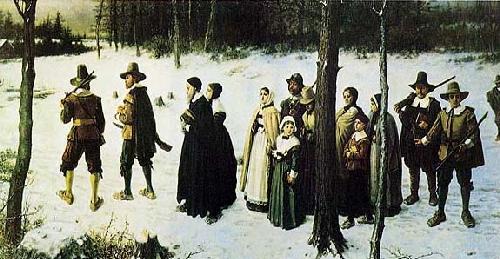
This past Thanksgiving weekend graced those of us in the church with unusual leisure as compared to years past. Often enough, the Sunday after Thanksgiving is the first Sunday in Advent, so we no sooner carve the turkey and finish up the last football game than we turn our attention to purple candles and evergreens. Conspiring with the market and its Black Fridays and Cyber Mondays, the church calendar often hurries us through Thanksgiving so that we can embrace the coming Christmas season.
But not this year. This year we have an extra week between the Thanksgiving weekend and the beginning of Advent, which brings with it extra time to linger in the importance of this season of gratitude. We can savor Thanksgiving leftovers—literally and figuratively—just a little longer, before diving into the ironic frenzy that is Advent waiting.
What to do with the extra time? For me, the absence of Advent’s impatient breath over the shoulder of my Thanksgiving observance allowed me just a little more time to think about this holiday in its own right—the gratitude it encourages in us and from us, the significance of a moment of thanks in a world with so much not right, the origins and meanings of this quintessential American celebration.
What Forbearance Is Not
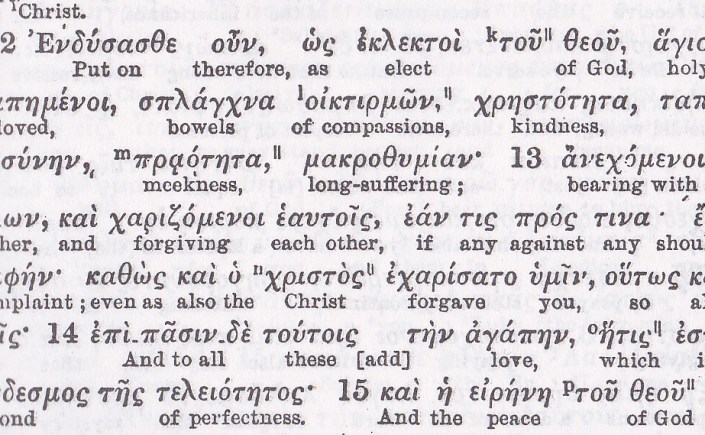
The biblical idea of forbearance is an underappreciated metaphor for divine grace and an underutilized concept for capturing how Christians ought to replicate that grace in the project of living together in community. To be sure, not much has been made of this idea in classical or contemporary biblical commentary. In his commentaries on Ephesians and Colossians, for instance, John Calvin leaves the term “forbearance”—the Greek anecho meaning “to bear with” or “to hold up”— without comment, skipping past it on his way to elucidating other parts of the passages where it appears (Eph. 4:1–3 and Col. 3:12–14). Similarly, most modern commentaries do not linger on the idea of forbearance as the linchpin for these passages.
Perhaps one of the reasons for its current unpopularity is that the term sounds like a call to yield, which unsurprisingly is not what people want to hear when they are embroiled in protracted disagreements over convictions they consider essential to Christian faithfulness. A couple of years ago, in the run-up to the latest denominational battle over same-sex marriage in the Presbyterian Church (USA), the faculties of two seminaries—Columbia Theological Seminary (GA) and Austin Theological Seminary (TX)—issued statements calling for forbearance in the debate. Insisting that schism in the church is a “profound pastoral and theological problem,” the Columbia and Austin faculties implored their fellow Presbyterians to bear with each other in the debate over amendments to the denominational constitution that would allow ordained ministers to officiate at same-sex marriages. In particular, the Columbia Seminary statement notes the way tag-words like “purity” and “inclusivity” have been weaponized in an increasingly hostile ideological environment. Calling on Presbyterians to repent of this hostility and work constructively toward a healthier future for the church, the Columbia faculty modeled this attitude by disavowing their own contributions to the polarization in the PC(USA). Citing biblical authority and denominational precedent, both statements argued that a spirit of forbearance, of “endeavoring to hear and take seriously the convictions of others,” was the only way to forestall further division in the church. Indeed, they suggested that a spirit of forbearance in this controversy would testify to the true source of the church’s hope, the One who calls the church together.
Reformation and Revolution

A sermon preached at the Congregational Church of Middlebury, Vermont on October 29, 2017
Five hundred years ago this week, Martin Luther is purported to have reached his limit in his frustration over abusive practices in the Roman church, nailing his 95 Theses—his 95 points of contention—to the church door in Wittenberg, prompting the public debate that would eventually lead to his break from the Roman church and the birth of Protestant Christianity. The Reformation was a game changer in the church, remaking the face of global Christianity. But the Reformation was not only a force in the church; it represented a cultural revolution. It transformed art and music by spurring the development of secular traditions of aesthetic expression. It transformed German national identity and literacy by contributing to the maturation of German language. It led to a revolution in science by helping to usher Europe into the modern period of knowledge acquisition. It led to a revolution in politics by directly contributing to the emergence of democratic principles and ideas like freedom of conscience and human rights.
The Reformation was a revolutionary force, not just for religion but for many other aspects of human culture and society. And this morning I want to suggest that recapturing the spirit of the Reformation just may be a catalyst for the cultural revolution we so desperately need in our moment. In this mire of injustice, incivility, and mutual suspicion in which we find ourselves, faced with the dual temptations of aggressive tribalism or cynical paralysis, we need a reformation of the American character. The church can help lead that reformation. But to do so, we must mobilize around a couple of enduring truths, convictions we inherit from that great revolution of five hundred years ago.
Long Live the Reformation!
On October 31, 1517, a German monk named Martin Luther publicly protested what he considered to be profound abuses in the Roman Church by posting a list of his objections to the church door in Wittenberg. Nailing matters like these on the church door was a customary way of initiating debate in that time and place. Despite the common practice, though, those 95 Theses were no ordinary bulletin board material. Luther was calling into question deeply rooted practices in the medieval church—the paying of indulgences to buy loved ones out of purgatory, the assumption that the pope’s mediation was necessary for Christians to experience the grace of Christ, and the emphasis on deeds performed as a way of earning one’s way into God’s mercy. Dissatisfaction in the church over these practices and others had simmered for centuries in the medieval church, but in the 16th century Luther’s 95 Theses became a flashpoint for reform, igniting revolutionary changes in the Christian Church all across Europe—turning the Church upside down.
From that revolution was born Lutheran Churches, Calvinist Churches, Anglican Churches, and eventually Methodists, Mennonites, Baptists, and others. From that revolution also emerged a Roman Catholic Church that was significantly different than the one from which Luther broke. Reformation Sunday—this year on October 29—annually celebrates the richness of Christian pluralism and the beginning of Christianity’s entrance into modernity. Reformation Sunday also reminds us of some of the fundamental theological convictions for which our Protestant ancestors labored so mightily. In an age in which most American Protestants struggle to define Protestant identity as anything beyond being generically “American,” it seems good to reserve a day each year to think intentionally about our Reformation inheritance. And it’s especially appropriate this year, as we commemorate the five hundredth anniversary of the 95 Theses. Here, then, are seven examples of the theological legacy of the Reformers.


You must be logged in to post a comment.