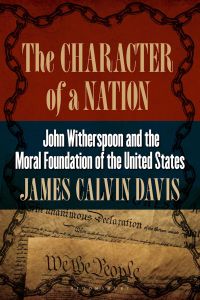
Announcing My New Book! The Character of a Nation: John Witherspoon and the Moral Foundation of the United States

I am happy to announce that Bloomsbury Publishing has just released my latest book, The Character of a Nation: John Witherspoon and the Moral Foundation of the United States. The book explores the political vision of John Witherspoon (1723–1794), a founding father of both the American Presbyterian Church and the United States. As a preacher, college president (Princeton), political leader, and signer of the Declaration of Independence, Witherspoon insisted that the success of the American Revolution and the new republic depended on people with good political character—an investment in the common good, a respect for moral law, and a priority on the protection of human rights. Without these commitments among citizens and their leaders, Witherspoon believed the new United States was doomed to fail.

The book examines how Witherspoon conceived of this kind of political character, what kinds of institutions he thought were necessary to cultivate it, and what effect he thought it should have on Americans’ views of war, government, and political dissent. The book also deals carefully with Witherspoon’s own hypocrisy on matters of moral character, given that he was complicit in racial slavery. Ultimately, The Character of a Nation invites us to consider what it means for us today to be a nation founded by leaders like Witherspoon, at once eloquent on ideals of life, liberty, and the common pursuit of happiness while also responsible for the sin of racial violence that continues to plague us today.

Exciting news!

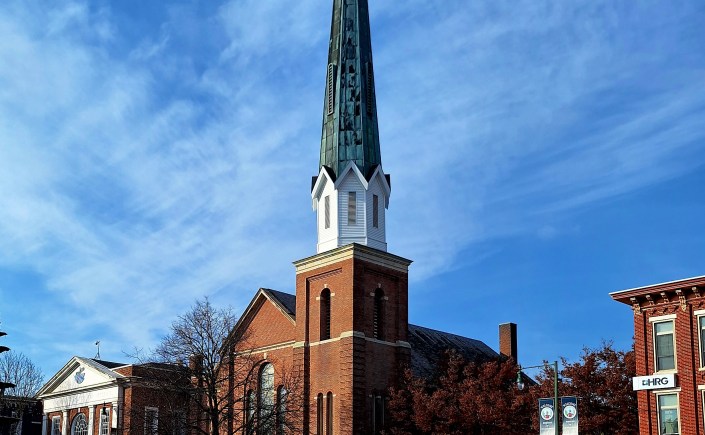
Big news for friends and followers of this site! As of July 1, 2026, I will be drawing my 25 years of teaching at Middlebury College to a close. The wonderful people of Central Presbyterian Church in Chambersburg, Pennsylvania, have called me to be their pastor and head of staff. While I will miss my colleagues, friends, and students at Middlebury, I am so excited for this opportunity to preach weekly and engage in the project of Capacious Christianity with such a great congregation. Plus, Elizabeth and I will be returning to our Pennsylvania roots! Included below is video of last Sunday’s service at Central, where I preached and the congregation voted on my call. See for yourself what a vibrant community “Central on the Square” is!


Dogs: A Theological Palindrome

A sermon preached at the Congregational Chuch of Middlebury (VT) on August 3, 2025

Texts: Genesis 2:15–22; 1 Corinthians 13

Friends, in my time with you all this summer, I have talked about some weighty considerations to being Christian in our particular moment. In June, I suggested that the most important witness we could offer in this divisive and dehumanizing time is to stand for the capaciousness in the Christian Gospel, the Good News that God loves all of us, that God desires relationship with all of us, and that God calls us to exercise this wide embrace in our relationships with others as an antidote to the hate all around us. Last month, I suggested that liberal Christianity ought to embrace a robust role in our political life, even engaging in partisan debates when it is clear that particular parties and politicians stand for values we consider godly and others clearly do not.

Today I want to talk with you about a dimension of the Christian life that is at least as important as these topics, one that some of you practice with righteous enthusiasm day after day, but that others of you may find a challenge to your sense of Christian responsibility. I want to talk to you today about the theological importance, the importance to a godly life, of dogs.

Continue reading

IRS just removed limits on church involvement in politics

Why that’s great news for liberal Christianity

Church and State: A sermon preached at the Congregational Church of Middlebury (VT) on July 13, 2025

Texts: 1 Samuel 8:4–22a; Romans 13:1–7

Friends, I would like to think with you this morning about two things that the aphorism tells us we should never discuss in polite company, certainly not together: religion and politics. You may have seen that the IRS released a policy change this past week on churches and other tax-exempt charitable organizations engaging in partisan politics. For decades, churches have been barred from endorsing particular candidates for public office, at risk of losing their tax-exempt status. This is a result of the so-called Johnson Amendment of 1954, and it has been the policy of the IRS ever since: churches cannot endorse specific partisan candidates for public office. But that prohibition has been skirted and violated by churches without much repercussion, sometimes creatively and more recently rather boldly. Conservative evangelical organizations have sued to change the policy, and this week, the IRS said OK. Churches can engage in partisan politics with no penalty.

It will surely come as a surprise to some of you that I think this is a remarkably good development. I will make the argument this morning for why I think it is a good development—more precisely, I will make four arguments: a theological argument, a historical argument, a practical argument, and, finally, a moral argument.

Continue reading

Christian Faith Sometimes Calls for Political Dissent

As a Presbyterian clergyperson, I belong to a regional judicatory called Albany Presbytery, and this spring Albany Presbytery released a statement objecting—as a matter of Christian principle—to destructive developments in US politics around immigration, social services, public discourse, and other parts of the common good. I was honored to participate in drafting that statement, and I am proud to see that it’s getting some attention on the national stage.