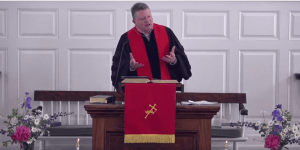
Easter Perspective

An Easter sermon preached at Putnam and Hebron Presbyterian Churches in NY in April 2026

Text: 1 Peter 1:3–9

Friends, here we are once again, celebrating the greatest season of the year. Easter! The resurrection of the Lord. In the Easter good news, we not only revel in God’s intention to save us from ourselves, to save us to God’s love, but we also bask in the confidence that God can accomplish our salvation. How do we know this? Because God raised Jesus from the dead.

This is the heart of the Gospel, that the whole world—including us—is subject to the powerful grace of God in Jesus Christ. That Gospel was accomplished at Easter, and it is what makes this the greatest season in the Christian year.

We can affirm the goodness and wonder in Easter, though, and still struggle to revel in it as much as we should. The joy and goodness of this season can be hard to sustain in our present moment, when so many of us are weighed down with anxiety over the world, our nation, our families, our friends, ourselves.

The economy brings us worry, as basic necessities get harder to afford, despite politicians trying to convince us otherwise. The hubris of technocrats threatens to overturn what it means to be human—with machines to drive our cars, do our thinking, and tell us right and wrong.

Illness haunts us, exacerbated by the struggle millions of Americans have securing health insurance, our nation having decided that health is a commodity we are comfortable letting corporations put a price tag on. The airports are a mess, the world thinks we’ve gone nuts, and many of our neighbors have learned to dislike each other because they don’t share each other’s politics.

With all that’s going on in the world, we might be excused if we struggle to appreciate the Easter good news. Where’s the good news in all that surrounds us? Well, in a word, nowhere, and that’s kind of the point of Easter. The good news of Easter isn’t to be found in economic prosperity, technological advances, or the brilliant minds governing us from Washington DC. The good news that saves us is to be found in God. The good news is in the truth declared to us in the crucifixion and resurrection of Jesus Christ: that our economy and our politics and our health and our spiritual lives and our families and our local communities and our world are all caught up in the saving grace of God in Jesus Christ. Whether the signs of that grace are obvious to us or seem scarce, God’s grace is here—triumphantly here—working in all of us by the Spirit of the living Christ and moving us along an arc toward the kingdom of God.

Continue reading
Dogs: A Theological Palindrome

A sermon preached at the Congregational Chuch of Middlebury (VT) on August 3, 2025

Texts: Genesis 2:15–22; 1 Corinthians 13

Friends, in my time with you all this summer, I have talked about some weighty considerations to being Christian in our particular moment. In June, I suggested that the most important witness we could offer in this divisive and dehumanizing time is to stand for the capaciousness in the Christian Gospel, the Good News that God loves all of us, that God desires relationship with all of us, and that God calls us to exercise this wide embrace in our relationships with others as an antidote to the hate all around us. Last month, I suggested that liberal Christianity ought to embrace a robust role in our political life, even engaging in partisan debates when it is clear that particular parties and politicians stand for values we consider godly and others clearly do not.

Today I want to talk with you about a dimension of the Christian life that is at least as important as these topics, one that some of you practice with righteous enthusiasm day after day, but that others of you may find a challenge to your sense of Christian responsibility. I want to talk to you today about the theological importance, the importance to a godly life, of dogs.

Continue reading

Capacious Christianity

A Pentecost sermon preached at the Congregational Church of Middlebury, VT, on June 8, 2025

Friends, I want to suggest to you today that we are ripe for a new Pentecost. The world in our moment needs people who are set afire and possessed with a message of grace and hospitality and inclusion, to push against the destructive trinity of arrogance, fear, and dehumanization that now reigns. We need a new Pentecost. We need the rebirth of capacious Christianity.

Click the link below to watch the full sermon:
https://www.facebook.com/MiddUCC/videos/3955528118003925

Birth Pangs

A sermon preached at Putnam United Presbyterian Church November 17, 2024

Text: Mark 13:1–27

Well, we can say this much: another presidential election is over. Roughly half of the country is pumped and feeling bullish about the future, while the other half is collecting canned foods and researching bomb shelters online. But we can say this pretty confidently: no matter who you were rooting for, this election cycle was brutal to endure. I made the comment last month during the concerns and joys that the only thing that seems to unite Americans these days is the nausea we all were feeling about the election.

A cloud of doom settled in over this election and the perception many of us have about the health of our country and state of the world, and this pessimism really was a nonpartisan experience. We saw it in Republican TV ads that depicted the US as being overrun by marauders from the south and cast into a new Great Depression by an economy allegedly driven into the ground. Democrats matched those doom-and-gloom pictures of the country with their own predictions of the end of democracy and Western civilization if they lost. And since the Democrats lost (in spectacular fashion), the anguish has only intensified with Democratic leaders and voters wearing black, crying openly, packing go bags, and either doomscrolling addictively or retreating from social media as if it were the comforting days of the 1990s.

Wherever you are on the political spectrum, if you’ve been paying attention to politics, our reality has felt ominous to you at some point recently. Today’s Gospel reading fits right into our current collective mood, because there is a lot of doom in this story, too.

Continue reading

Who Are God’s People?

A sermon preached at Putnam Presbyterian Church on September 8, 2024

Sermon text: Mark 7:24–30

Of all the stories of Jesus told to us by the Gospel writers, this one is—hands-down—the least flattering. In the first part of the Gospel of Mark, Jesus is wandering around, teaching and performing miracles, but largely staying out of the spotlight, for he has decided that the time has not yet come to reveal himself in full to the world. In that spirit, he sneaks into a house in the region of Tyre, presumably with a sympathetic follower, perhaps to catch a meal and some rest. But his reputation precedes him, and soon a woman intrudes and sits at his feet. This woman is a Gentile, which in biblical parlance means that she is not Jewish. And in case we didn’t catch that important detail, the storyteller emphasizes that she is Syrophoenician. She is not Jewish, but she comes to this Jewish healer with a dire need. Her daughter is ill. In that ancient worldview, the girl is considered to have a demon, and she needs help. So her mother falls at the feet of Jesus and begs him to come and lay hands on her daughter.

Jesus’ response is abrupt, and, to readers of this story ever since, very puzzling. He says to her, “Let the children be fed first, for it is not fair to take the children’s food and throw it to the dogs.” Translation: I am here for the people of Israel, not for Gentiles. But not only does he refuse to help her because she is not Jewish, the way he puts it peddles in insults. Dogs he calls her kind. The Messiah of God refers to Gentiles as animals.

Continue reading