As a Presbyterian clergyperson, I belong to a regional judicatory called Albany Presbytery, and this spring Albany Presbytery released a statement objecting—as a matter of Christian principle—to destructive developments in US politics around immigration, social services, public discourse, and other parts of the common good. I was honored to participate in drafting that statement, and I am proud to see that it’s getting some attention on the national stage.
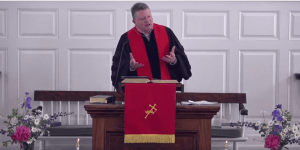
A Pentecost sermon preached at the Congregational Church of Middlebury, VT, on June 8, 2025
Friends, I want to suggest to you today that we are ripe for a new Pentecost. The world in our moment needs people who are set afire and possessed with a message of grace and hospitality and inclusion, to push against the destructive trinity of arrogance, fear, and dehumanization that now reigns. We need a new Pentecost. We need the rebirth of capacious Christianity.
A sermon preached at Putnam United Presbyterian Church November 17, 2024
Text: Mark 13:1–27
Well, we can say this much: another presidential election is over. Roughly half of the country is pumped and feeling bullish about the future, while the other half is collecting canned foods and researching bomb shelters online. But we can say this pretty confidently: no matter who you were rooting for, this election cycle was brutal to endure. I made the comment last month during the concerns and joys that the only thing that seems to unite Americans these days is the nausea we all were feeling about the election.
A cloud of doom settled in over this election and the perception many of us have about the health of our country and state of the world, and this pessimism really was a nonpartisan experience. We saw it in Republican TV ads that depicted the US as being overrun by marauders from the south and cast into a new Great Depression by an economy allegedly driven into the ground. Democrats matched those doom-and-gloom pictures of the country with their own predictions of the end of democracy and Western civilization if they lost. And since the Democrats lost (in spectacular fashion), the anguish has only intensified with Democratic leaders and voters wearing black, crying openly, packing go bags, and either doomscrolling addictively or retreating from social media as if it were the comforting days of the 1990s.
Wherever you are on the political spectrum, if you’ve been paying attention to politics, our reality has felt ominous to you at some point recently. Today’s Gospel reading fits right into our current collective mood, because there is a lot of doom in this story, too.
Five hundred years ago this week, Martin Luther is purported to have reached his limit in his frustration over abusive practices in the Roman church, nailing his 95 Theses—his 95 points of contention—to the church door in Wittenberg, prompting the public debate that would eventually lead to his break from the Roman church and the birth of Protestant Christianity. The Reformation was a game changer in the church, remaking the face of global Christianity. But the Reformation was not only a force in the church; it represented a cultural revolution. It transformed art and music by spurring the development of secular traditions of aesthetic expression. It transformed German national identity and literacy by contributing to the maturation of German language. It led to a revolution in science by helping to usher Europe into the modern period of knowledge acquisition. It led to a revolution in politics by directly contributing to the emergence of democratic principles and ideas like freedom of conscience and human rights.
The Reformation was a revolutionary force, not just for religion but for many other aspects of human culture and society. And this morning I want to suggest that recapturing the spirit of the Reformation just may be a catalyst for the cultural revolution we so desperately need in our moment. In this mire of injustice, incivility, and mutual suspicion in which we find ourselves, faced with the dual temptations of aggressive tribalism or cynical paralysis, we need a reformation of the American character. The church can help lead that reformation. But to do so, we must mobilize around a couple of enduring truths, convictions we inherit from that great revolution of five hundred years ago.




 James Calvin Davis
You must be logged in to post a comment.