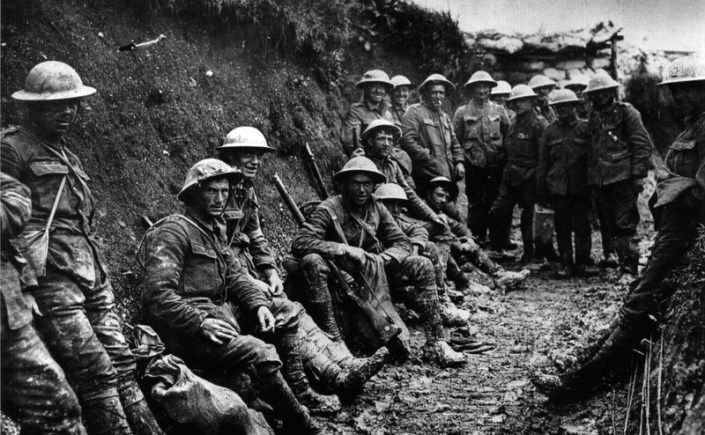
The End of War

“The war to end war” or “the war to end all wars”—Woodrow Wilson’s borrow from H.G. Wells to justify World War I was met with cynicism even during the First World War, and since then has become a sardonic lament. Here, on the one hundredth anniversary of the end of that war, we know it ended nothing. The culmination of that conflict directly contributed to the rise of the Second World War, the end of which fed the conflicts in Korea and Southeast Asia, which motivated interventions in the Middle East, and on and on and on…. World War I ended nothing; instead it contributed to the bloodiest century in human history.

The persistence of war in our world prompts the question for Christians: should we even expect the end of war? Is war a scourge to eliminate, or is it a necessary evil that we sometimes endure or even actively utilize? Should Christians be opposed to war, even when undertaken in the name of justice and peace?

Continue reading

Miraculous Abundance

Convention suggests that what makes a miracle a miracle is its magical quality—something that is otherwise inexplicable, that bends the logic of time, space, or causality. That’s literally the definition of a miracle: “a surprising and welcome event that is not explicable by natural or scientific laws and is therefore considered to be the work of a divine agency.” I know, because I Googled it. There are plenty of accounts in the Scriptures that follow this definition, and there are plenty of people today who believe in these kinds of miracles and wait on them in their lives. But if you struggle with the idea that God regularly works by suspending the laws of nature, then these miraculous stories may become less compelling to you. We may be tempted to ignore or dismiss them because they seem so fantastical, because they run counter to the way we understand the world to work. No less a thinker than Thomas Jefferson famously rejected the biblical miracle stories for just this reason, literally cutting them out of his Bible. And if we find the stories themselves unbelievable, then we may not be persuaded that the point they’re trying to make with tales of wonder is compelling either.

Continue reading

The Importance of Being Father

Truth be told, after thirteen years of fatherhood, I have to admit that I still am not used to thinking about myself in the context of Father’s Day. Father’s Day doesn’t feel like it’s about me, at least not intuitively. On Father’s Day I reflect on my own father. I remember the very good moments with my dad, moments that in some ways get more poignant as he and I get older and the relationship roles reverse just a bit. I think about the ways in which I am shaped by being the son of an Appalachian coal miner, influences that go down to my core, accidental on his part, but molding who I am as a person and as a professional. These days I spend a little of Father’s Day telling myself I’ll be more faithful this year in calling home and visiting. On Father’s Day, I think like a son. It continues to catch me a bit by surprise that this day could also be about me.

And yet, being a father is who I am, and with every passing year it becomes as formative to my character as being a son. My sense of self and my responsibilities in this life are defined in large part from the duties of parenthood; my calendar certainly reflects that I have two jobs now. I think as a father now, too. In the classroom, I approach many of the ethical issues I teach with different eyes. In the airport, my heart beats faster when I hear a small voice crying. I know more about circumstances we broadly refer to as “special needs” than I ever did before. I am more invested and interested in a place and culture on the other side of the world (where my sons were born) than I ever was before. I watch baseball and NASCAR now; as it turns out, there are sports other than football played in this country! I am father now.

Continue reading

The Christian Misanthrope

Can you be a Christian misanthrope? The Merriam-Webster Dictionary defines a misanthrope as “a person who hates or distrusts humankind.” Precisely used, the term refers to someone who retreats from human interaction out of a rejection of human community. Understood as such, it should be pretty clear that you can’t be a Christian misanthrope, for that’s a contradiction in terms. Christianity’s emphases on love and community make our faith tradition obviously incompatible with someone who would declare that he is done with humanity.

So I will admit that the phrase “Christian misanthrope” is a bit of intentional literary exaggeration, an oxymoron meant to grab attention. But I also use the term because I have been called a misanthrope from time to time—kiddingly, I hope, by friends who know my strong preference for alone time and independence. Even to call it a “strong preference” seems an understatement. I often tell people that when I underwent my psychological evaluation for ordination to ministry, my tests concluded that if I were any more introverted, I would quite simply be dead. My default is to be alone; it requires intention for me to seek out the company of other people. I like quiet; I often prefer time to talk to myself over talking with others. A good weekend to me is spent walking in the woods behind my house, sitting on my porch staring at the deer in the field across the way, or tinkering with a project in my garage.

Continue reading

MLK and Civility in an Era of Shitholes

The president is at it again. This week, in a White House meeting on immigration reform, and just days before the celebration of Martin Luther King Jr. Day, Mr. Trump apparently let loose with disparaging comments about Haiti and various African nations suffering from natural disasters, poverty, or underdevelopment. He called them “shithole” countries, and he wondered aloud why we should want to invite immigrants from those places, instead of from places like Norway. The comments, confirmed by both Democrats and Republicans in the room, exhibit clear racial undertones, and they continued Mr. Trump’s tendency toward racially ignorant public rhetoric (think Mexican rapists and the “good people” he assumed to be among the white supremacists in Charlottesville). Rather than serving the cause of unity, the president’s remarks further stoked the racial antagonism and injustice that is our national crisis.

For the past decade, I have been writing and speaking about the need for more civility among American leaders and citizens. I define civility as the exercise of patience, humility, integrity, and mutual respect in public life, even (or especially) with those with whom we disagree. Civility is a set of virtues that we need to actively cultivate in each other, in our relationships and our civic institutions, as the public ethos that guarantees the health and effectiveness of democratic politics. (My most recent book argues for a Christian version of these norms that I call forbearance.)  Without this commitment to open and constructive dialogue, rooted in a genuine respect for others as fellow participants in public life, the future of democracy looks grim.

Continue reading