IRS just removed limits on church involvement in politics

Why that’s great news for liberal Christianity

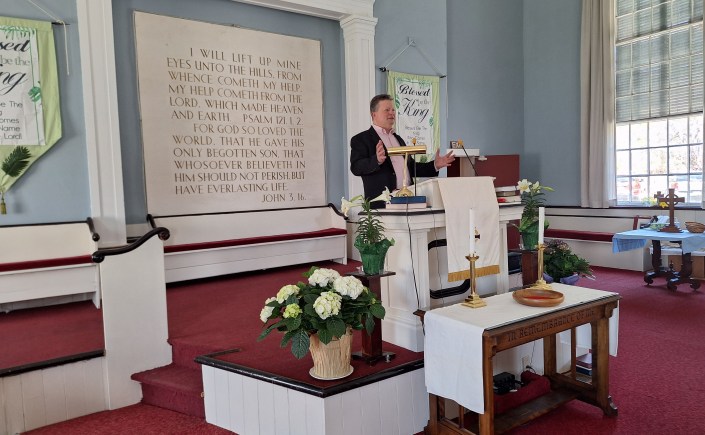
Church and State: A sermon preached at the Congregational Church of Middlebury (VT) on July 13, 2025

Texts: 1 Samuel 8:4–22a; Romans 13:1–7

Friends, I would like to think with you this morning about two things that the aphorism tells us we should never discuss in polite company, certainly not together: religion and politics. You may have seen that the IRS released a policy change this past week on churches and other tax-exempt charitable organizations engaging in partisan politics. For decades, churches have been barred from endorsing particular candidates for public office, at risk of losing their tax-exempt status. This is a result of the so-called Johnson Amendment of 1954, and it has been the policy of the IRS ever since: churches cannot endorse specific partisan candidates for public office. But that prohibition has been skirted and violated by churches without much repercussion, sometimes creatively and more recently rather boldly. Conservative evangelical organizations have sued to change the policy, and this week, the IRS said OK. Churches can engage in partisan politics with no penalty.

It will surely come as a surprise to some of you that I think this is a remarkably good development. I will make the argument this morning for why I think it is a good development—more precisely, I will make four arguments: a theological argument, a historical argument, a practical argument, and, finally, a moral argument.

Continue reading
Christian Faith Sometimes Calls for Political Dissent

As a Presbyterian clergyperson, I belong to a regional judicatory called Albany Presbytery, and this spring Albany Presbytery released a statement objecting—as a matter of Christian principle—to destructive developments in US politics around immigration, social services, public discourse, and other parts of the common good. I was honored to participate in drafting that statement, and I am proud to see that it’s getting some attention on the national stage.

Birth Pangs

A sermon preached at Putnam United Presbyterian Church November 17, 2024

Text: Mark 13:1–27

Well, we can say this much: another presidential election is over. Roughly half of the country is pumped and feeling bullish about the future, while the other half is collecting canned foods and researching bomb shelters online. But we can say this pretty confidently: no matter who you were rooting for, this election cycle was brutal to endure. I made the comment last month during the concerns and joys that the only thing that seems to unite Americans these days is the nausea we all were feeling about the election.

A cloud of doom settled in over this election and the perception many of us have about the health of our country and state of the world, and this pessimism really was a nonpartisan experience. We saw it in Republican TV ads that depicted the US as being overrun by marauders from the south and cast into a new Great Depression by an economy allegedly driven into the ground. Democrats matched those doom-and-gloom pictures of the country with their own predictions of the end of democracy and Western civilization if they lost. And since the Democrats lost (in spectacular fashion), the anguish has only intensified with Democratic leaders and voters wearing black, crying openly, packing go bags, and either doomscrolling addictively or retreating from social media as if it were the comforting days of the 1990s.

Wherever you are on the political spectrum, if you’ve been paying attention to politics, our reality has felt ominous to you at some point recently. Today’s Gospel reading fits right into our current collective mood, because there is a lot of doom in this story, too.

Continue reading

Who Are God’s People?

A sermon preached at Putnam Presbyterian Church on September 8, 2024

Sermon text: Mark 7:24–30

Of all the stories of Jesus told to us by the Gospel writers, this one is—hands-down—the least flattering. In the first part of the Gospel of Mark, Jesus is wandering around, teaching and performing miracles, but largely staying out of the spotlight, for he has decided that the time has not yet come to reveal himself in full to the world. In that spirit, he sneaks into a house in the region of Tyre, presumably with a sympathetic follower, perhaps to catch a meal and some rest. But his reputation precedes him, and soon a woman intrudes and sits at his feet. This woman is a Gentile, which in biblical parlance means that she is not Jewish. And in case we didn’t catch that important detail, the storyteller emphasizes that she is Syrophoenician. She is not Jewish, but she comes to this Jewish healer with a dire need. Her daughter is ill. In that ancient worldview, the girl is considered to have a demon, and she needs help. So her mother falls at the feet of Jesus and begs him to come and lay hands on her daughter.

Jesus’ response is abrupt, and, to readers of this story ever since, very puzzling. He says to her, “Let the children be fed first, for it is not fair to take the children’s food and throw it to the dogs.” Translation: I am here for the people of Israel, not for Gentiles. But not only does he refuse to help her because she is not Jewish, the way he puts it peddles in insults. Dogs he calls her kind. The Messiah of God refers to Gentiles as animals.

Continue reading