Christian Faith Sometimes Calls for Political Dissent

As a Presbyterian clergyperson, I belong to a regional judicatory called Albany Presbytery, and this spring Albany Presbytery released a statement objecting—as a matter of Christian principle—to destructive developments in US politics around immigration, social services, public discourse, and other parts of the common good. I was honored to participate in drafting that statement, and I am proud to see that it’s getting some attention on the national stage.

Cancel Culture and Christian Grace

A sermon preached in Upstate New York, June 2023

Sermon text: Matthew 7:1–5, 12

A couple weeks ago, I saw a story in the news about the play-by-play announcer for the Oakland A’s being fired after more than twenty years of broadcasting for the team. Apparently, the afternoon before his last game, Glen Kuiper visited the Negro Leagues Baseball Museum. He got an extensive tour of the place, and he was so impressed with the museum and the history of the barriers Black baseball players endured, and the depth to that history that he didn’t know—even though he worked in baseball—that he wanted to talk about it during the baseball game. Unfortunately, though, when he started talking about his experience, he fumbled the name of the museum, and it came out sounding an awful lot like the other N-word that no one should say in private, let alone over a broadcast.

The reaction was swift and furious, just as you’d expect, and in came the calls for Kuiper to be fired. Kuiper insisted that he did not mean to say the wrong word, he just got tongue-tied—an explanation that seems plausible to me, someone else who spends much of his profession in public speaking. Sometimes my brain and my mouth don’t communicate effectively, and what my brain wants to say does not come out the way I thought it. And sometimes, in situations less wrought than this one, in an effort to make sure I don’t say something a certain way, I get so focused on avoiding that construction that my brain sends that signal and I end up saying it precisely the way I was trying to avoid. (I do that with names all the time.) I can imagine that Kuiper, a White man, was already feeling a little funny saying the word “Negro,” because even though it’s in the name of the museum, in a lot of other contexts it is not a positive word to use to refer to Black persons. So even that hyper-sensitivity could have caused him to misspeak.

Continue reading

Conflict, Civility, and Roger Williams

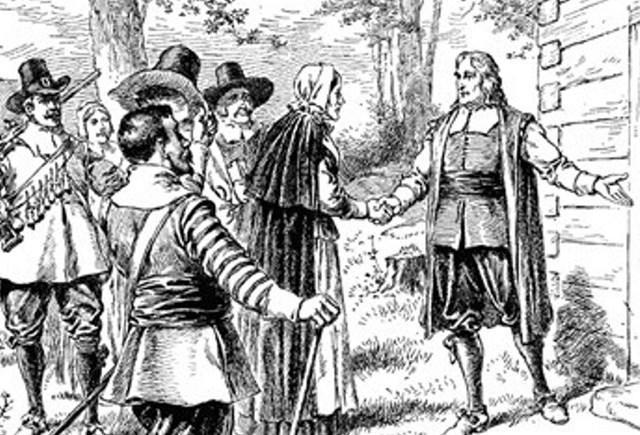
For twenty years I’ve been writing and talking about civility, the public virtues necessary for a healthy democracy. My work on civility got its start in a dissertation and two subsequent books on Roger Williams, the founder of Rhode Island and the first American prophet for religious freedom.

Recently I enjoyed a rare opportunity to talk about his importance for a podcast called Multifaith Matters, which “explores various facets of loving God and multifaith neighbors through interviews with pastors, ministry leaders, and scholars” and “models neighborly multifaith conversations with members of various religious traditions.” The podcast is produced by Multi-Faith Matters dot org, an organization whose mission is to “help evangelicals fulfill the Great Commission and the Great Commandments (love of God and neighbor) while maintaining faithfulness to evangelical convictions.” To achieve this, they facilitate dialogue and relationships among people of all faiths.

Roger Williams is known for his religious toleration, but he was also fiercely dogmatic, and his ability to hold together deeply held convictions and respect for others makes him an interesting case study for our time. In our conversation here, after a brief biographical sketch, I delve into Williams’s ideas about the Puritan establishment in Massachusetts, natural law, religious freedom, civility, and the proper relationship between church and society.

You can listen to the podcast here on its website, or via several other podcast platforms, including Spotify.

You can also watch the interview here!

A Word of Grace and Truth

Grace and truth. Neither is in great supply these days. Grace and truth can be scarce in the church or at family holiday gatherings, but they are virtually unicorns in American politics, rumored to be real but never actually seen. In our post-fact era, there is no such thing as truth, for reality is whatever my favorite cable channel or internet site says it is. And in our hyper-partisan political culture, where political opponents are no longer fellow citizens but enemies of the people, grace gives way to demonization. In the eyes of Democrats, Republicans are racist, cowardly, and enslaved to the wealthy elite. In the standard rhetoric of Republicans, Democrats are anti-religious intellectuals bent on undermining American security with open borders, while redistributing wealth to eliminate the need to work. The absence of grace and truth in our politics increasingly bleeds into how we relate to our neighbors, family members, and church kin.

Continue reading