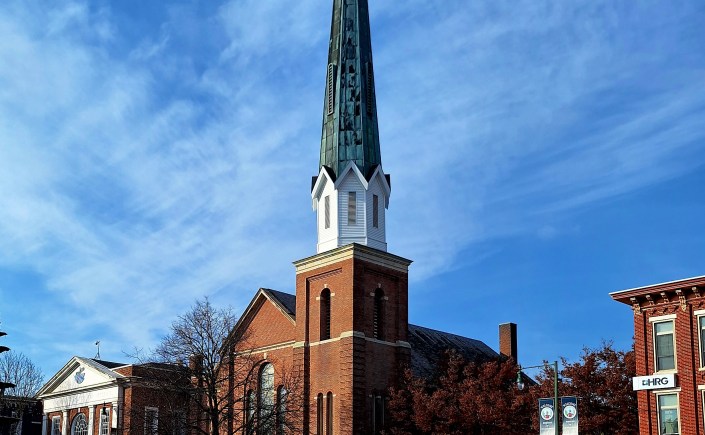
Sanctuary

This summer I have been watching a CNN documentary mini-series called Jerusalem: City of Faith and Fury. One historian on the show invokes the saying, “the past is never the past,” and goes on to remark that “if there is one place on earth where that is true, it is Jerusalem.” What makes Jerusalem the most conflicted place on earth is the number of communities who lay claim to the city, especially the historical depths of those claims. The three Abrahamic faiths all claim Jerusalem as a holy city, and their adherents regularly make pilgrimage to it. The importance of Jerusalem has led to millennia of contested claims to the city that continue to this day, for Jerusalem physically captures a sense of the holy for the groups who lay claim to it; it symbolizes something important about the identity of those communities. To lose the city is to be displaced, to be cut off from the sacred in a visceral sense. This isn’t just about territory. It is about belief, identity, a sense of grounding in the moral cosmos, a connection with the holy. The city’s religious significance—and the Abrahamic faiths’ inability to imagine it as a shared space—is what makes the history of Jerusalem so tragic.

The conflict around Jerusalem is a particularly painful example of the intense importance of place to our sense of meaning. We are embodied creatures, so time and space are important to how we understand ourselves and our place in this world. Our sense of place reflects and gives identity, and when we are disconnected from meaningful places, we feel displaced—rudderless, vulnerable, perhaps not really ourselves.

Continue reading

“Six Practices” Podcast, Part 2

The second part of the episode “Six Practices that Can Unite Congregations in Times of Disagreement” is now available on the Pastors4Pastors podcast. (Part one can be found here.)

From the description:
In this second of a two-part episode we continue a conversation with James Calvin Davis, religion professor at Middlebury College in Vermont, Presbyterian minister, and the author of a book for just such a time as this: Forbearance: A Theological Ethic for a Disagreeable Church (Wm. B. Eerdmans Publishing Co., 2017). Joining the conversation is the Rev. Leeann Scarbrough, pastor of the First Presbyterian Church of Talladega, Alabama.

Dr. Davis talks about the meaning of forbearance and the six practices that can lead us back to unity even in our disagreement. James is also the author of In Defense of Civility: How Religion Can Unite America on Seven Moral Issues That Divide Us (Westminster John Knox Press, 2010).

We are confident you will find this conversation helpful as you seek to bring unity to your congregation.

Six Practices that Can Unite Congregations

Tune into this episode of my good friend Ken Broman-Fulks’s podcast, Pastors4Pastors, as we talk about Forbearance and the challenges to maintaining community in church and civil society in these tumultuous times. Joining us in the conversation are two other good friends who also happen to be Presbyterian pastors. The Rev. Leeann Scarbrough serves a church in Alabama, and the Rev. Susan Takis pastors in The Villages, a gigantic Florida retirement community where political tensions have made national news.

By the way, some time ago I wrote a piece on the theological importance of friendship that was inspired by time spent with these three amazing people. Ken’s podcast just goes to show that there is some thoughtfulness to this group, to go along with the shared fondness for bourbon.

Part two of our conversation on Forbearance will drop next week!

Closing Our Sanctuaries Is Not a First Amendment Violation

It is an expression of Christian charity


Lost in the traumatic aftermath of George Floyd’s murder, including President Trump’s assault on the right to free speech and peaceable assembly, the US Supreme Court issued a ruling on another First Amendment issue late last week. The case involved a church suing the State of California for prohibiting large in-person services during the COVID-19 pandemic. The church argued that assembling as church is a fundamental expression of Christian faith, and that the order to limit gatherings is therefore a violation of the First Amendment. A majority on the Supreme Court disagreed, ruling that the prohibitions on mass gatherings did not constitute a violation of religious freedom.


Continue reading