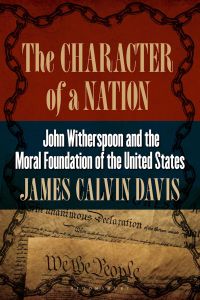
Announcing My New Book! The Character of a Nation: John Witherspoon and the Moral Foundation of the United States

I am happy to announce that Bloomsbury Publishing has just released my latest book, The Character of a Nation: John Witherspoon and the Moral Foundation of the United States. The book explores the political vision of John Witherspoon (1723–1794), a founding father of both the American Presbyterian Church and the United States. As a preacher, college president (Princeton), political leader, and signer of the Declaration of Independence, Witherspoon insisted that the success of the American Revolution and the new republic depended on people with good political character—an investment in the common good, a respect for moral law, and a priority on the protection of human rights. Without these commitments among citizens and their leaders, Witherspoon believed the new United States was doomed to fail.

The book examines how Witherspoon conceived of this kind of political character, what kinds of institutions he thought were necessary to cultivate it, and what effect he thought it should have on Americans’ views of war, government, and political dissent. The book also deals carefully with Witherspoon’s own hypocrisy on matters of moral character, given that he was complicit in racial slavery. Ultimately, The Character of a Nation invites us to consider what it means for us today to be a nation founded by leaders like Witherspoon, at once eloquent on ideals of life, liberty, and the common pursuit of happiness while also responsible for the sin of racial violence that continues to plague us today.
Podcast Interview: Pastors4Pastors

I recently had the opportunity once again to appear on my friend Ken Broman-Fulks’s podcast, Pastors4Pastors. We had a lot of fun talking about the themes running through the essays in my book:

Most pastors either embrace our American holidays without question or try to ignore them and hope our congregations won’t notice, which they always do. Our conversation with James Calvin Davis, author of American Liturgy: Finding Theological Meaning in the Holy Days of US Culture, is both edifying and entertaining!

— Ken Broman-Fulks

You can listen here, or wherever podcasts live (including Amazon Music!) If you’re a visual person, you can watch the interview (which also includes two of our other Presbyterian friends) on YouTube.

Don’t forget to subscribe to Ken’s podcast to get notified of future episodes.

American Liturgy — New Book Announcement

I’m thrilled to announce that my latest book is now available to order! Official launch information will follow soon. In the meantime, here is a description and link to the publisher’s website:

American Liturgy: Finding Theological Meaning in the Holy Days of US Culture

How can celebrating the “holy days” of American culture help us to understand what it means to be both Christian and American? In timely essays on Super Bowl Sunday, Mother’s Day, Independence Day, Thanksgiving, and other holidays of the secular calendar, James Calvin Davis explores the wisdom that Christian tradition brings to our sense of American identity, as well as the ways in which American culture might prompt us to discern the imperatives of faith in new ways. Rather than demonizing culture or naively baptizing it, Davis models a bidirectional mode of reflection, where faith convictions and cultural values converse with and critique one another. Focusing on topics like politics, race, parenting, music, and sports, these essays remind us that culture is as much human accomplishment and gift as it is a challenge to Christian values, and there is insight to be discovered in a theologically astute investment in America’s “holy days.”

Also available on Kindle!

Black Bodies and the Justice of God

To all Christians invested in the struggle for racial justice, I recommend Kelly Brown Douglas’s Stand Your Ground: Black Bodies and the Justice of God (Orbis, 2015). Written after the murder of Trayvon Martin, Douglas’s book puts white supremacy in historical perspective, arguing that Christians should acknowledge the complicity of their faith in America’s original sin. At the same time, she offers a compelling theology of witness with this clear theme: the crucified Christ stands in solidarity with black lives still being crucified today.


From the book:


“It matters that Jesus died on the cross, just as it matters that God freed the Israelites from bondage. For it is only when the least of these are free to achieve the fullness of life that God’s justice will be realized. The profound meaning of God’s preferential option for freedom is seen in God’s solidarity with the crucified class. Their freedom will mark an eradication of all that separates people one from another and thus disengages all people from the goodness of their humanity. Thus, the justice of God also begins from the bottom up. Put simply, it is in the freedom of those who are crucified that one can see the justice of God working in the world” (197).