IRS just removed limits on church involvement in politics

Why that’s great news for liberal Christianity

Church and State: A sermon preached at the Congregational Church of Middlebury (VT) on July 13, 2025

Texts: 1 Samuel 8:4–22a; Romans 13:1–7

Friends, I would like to think with you this morning about two things that the aphorism tells us we should never discuss in polite company, certainly not together: religion and politics. You may have seen that the IRS released a policy change this past week on churches and other tax-exempt charitable organizations engaging in partisan politics. For decades, churches have been barred from endorsing particular candidates for public office, at risk of losing their tax-exempt status. This is a result of the so-called Johnson Amendment of 1954, and it has been the policy of the IRS ever since: churches cannot endorse specific partisan candidates for public office. But that prohibition has been skirted and violated by churches without much repercussion, sometimes creatively and more recently rather boldly. Conservative evangelical organizations have sued to change the policy, and this week, the IRS said OK. Churches can engage in partisan politics with no penalty.

It will surely come as a surprise to some of you that I think this is a remarkably good development. I will make the argument this morning for why I think it is a good development—more precisely, I will make four arguments: a theological argument, a historical argument, a practical argument, and, finally, a moral argument.

Continue reading
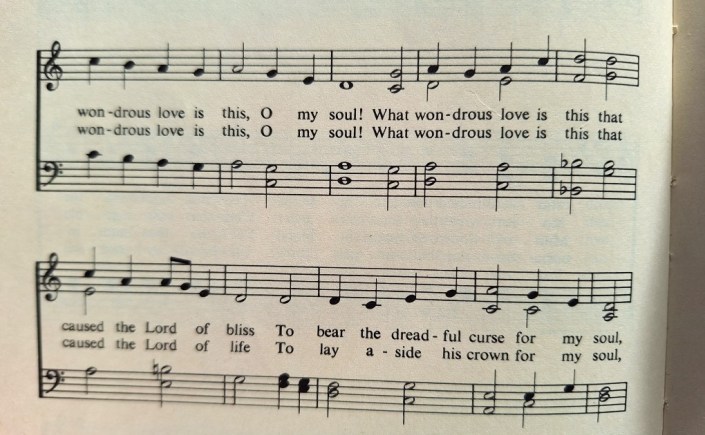
Wondrous Love

A sermon delivered at Putnam United Presbyterian Church (NY) 3/24/2024
Palm Sunday

Holy Week can be a particularly difficult week for Christians to focus, because there is a lot going liturgically and theologically. This one week puts before us the trajectory of Jesus’ final days, from popular hero to humiliated scapegoat. We witness the crowds hearing what they wanted to hear and seeing what they wanted to see in Jesus early in the week, only to reject him when they realized he was preaching a kingdom message that would challenge them, not placate them. They realized that he was unwilling to play the game that other would-be political leaders played. He would not promise to overthrow the Romans and their vermin sympathizers on day 1 of his rule. Instead, he talked on and on about a kingdom of love and righteousness and peace. And for this, the people’s chants of “Hosanna in the highest!” turned into mob taunts to hang him, and they abandoned him to the brutal devices of the Roman Empire.

Continue reading

Podcast Interview: Pastors4Pastors

I recently had the opportunity once again to appear on my friend Ken Broman-Fulks’s podcast, Pastors4Pastors. We had a lot of fun talking about the themes running through the essays in my book:

Most pastors either embrace our American holidays without question or try to ignore them and hope our congregations won’t notice, which they always do. Our conversation with James Calvin Davis, author of American Liturgy: Finding Theological Meaning in the Holy Days of US Culture, is both edifying and entertaining!

— Ken Broman-Fulks

You can listen here, or wherever podcasts live (including Amazon Music!) If you’re a visual person, you can watch the interview (which also includes two of our other Presbyterian friends) on YouTube.

Don’t forget to subscribe to Ken’s podcast to get notified of future episodes.

Holy War on Hate

Like many of you, I have been struggling with the news coming out of New Zealand a week or so ago. Fifty people were killed in an act of terror on two mosques in Christchurch, New Zealand. The victims’ only crime was gathering as Muslims for prayer. The attack was perpetrated by a man who identifies as a white nationalist, a resister to the alleged global effort to exterminate white people. His manifesto, meant to inspire others in the cause, was itself inspired by (among other influences) white nationalist rhetoric, efforts, and validations here in the United States. For a week the entire nation of New Zealand has been mourning fifty people killed in the name of hate.


I’ve been preoccupied with this news this week, and with the unimpeded rise in dangerous racist sentiment here and around the world. As a Christian, I also am underwhelmed by the response of the Church to moments like these. To be sure, many Christian denominations came out immediately with thoughtful and earnest denunciations of the violence and expressions of genuine sympathy and concern for the victims of this tragedy, and for New Zealand as a national community. But many of those statements strike my ear as somewhat innocuous, expressing genuine sorrow but not quite capturing the anger I have in moments like these. Our hearts go out to our Muslim sisters and brothers.… We must put an end to the violence…. Is this all that Christians can say?


Continue reading