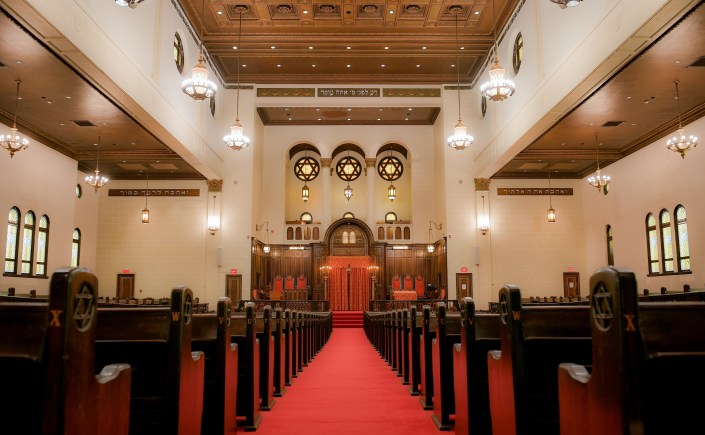
Christian Pro-Semitism

A sermon preached in August 2023 at Hebron United and Putnam United Presbyterian Churches

Sermon Text: Romans 11:1–2, 25–36

Many of us probably noted in the news this summer the conclusion of the case involving the Tree of Life Synagogue shooting in Pittsburgh, Pennsylvania in October 2018. Robert Bowers was convicted in June and sentenced to death earlier this month for killing eleven people gathered for worship at the synagogue. The sentence itself is worthy of a sermon, but not today. Today it is enough for the resolution of that case to remind us that antisemitism remains an acute problem in the United States. More than 3,600 acts of antisemitic hatred were committed in 2022, the largest number for a single year since the Anti-Defamation League started tracking such activity in 1979. Antisemitism is no more a relic of history than racism is. It is not something that plagued us in the past but that we have gotten over, an argument you hear with naïve frequency about racism. Racism remains a national problem, and so does antisemitism. In fact, both of these deeply rooted national sins have been given new permission in the caustic political culture in which we find ourselves.

And—like racism—something that Christian Americans need to wrestle honestly with is the complicity of our religious tradition in this national sin. Truth be told, antisemitism is a problem in the US because Christianity is so dominant in this country, and whether we like to admit it or not, antisemitism goes way back in our religious tradition.

Continue reading

Cancel Culture and Christian Grace

A sermon preached in Upstate New York, June 2023

Sermon text: Matthew 7:1–5, 12

A couple weeks ago, I saw a story in the news about the play-by-play announcer for the Oakland A’s being fired after more than twenty years of broadcasting for the team. Apparently, the afternoon before his last game, Glen Kuiper visited the Negro Leagues Baseball Museum. He got an extensive tour of the place, and he was so impressed with the museum and the history of the barriers Black baseball players endured, and the depth to that history that he didn’t know—even though he worked in baseball—that he wanted to talk about it during the baseball game. Unfortunately, though, when he started talking about his experience, he fumbled the name of the museum, and it came out sounding an awful lot like the other N-word that no one should say in private, let alone over a broadcast.

The reaction was swift and furious, just as you’d expect, and in came the calls for Kuiper to be fired. Kuiper insisted that he did not mean to say the wrong word, he just got tongue-tied—an explanation that seems plausible to me, someone else who spends much of his profession in public speaking. Sometimes my brain and my mouth don’t communicate effectively, and what my brain wants to say does not come out the way I thought it. And sometimes, in situations less wrought than this one, in an effort to make sure I don’t say something a certain way, I get so focused on avoiding that construction that my brain sends that signal and I end up saying it precisely the way I was trying to avoid. (I do that with names all the time.) I can imagine that Kuiper, a White man, was already feeling a little funny saying the word “Negro,” because even though it’s in the name of the museum, in a lot of other contexts it is not a positive word to use to refer to Black persons. So even that hyper-sensitivity could have caused him to misspeak.

Continue reading

Hope in the End Times

I had the pleasure of preaching on the First Sunday in Advent in my home church, the Congregational Church of Middlebury (VT). The theme of the sermon was “Hope in the End Times.” What do biblical depictions of apocalypse have to do with Advent waiting, particularly in a moment like ours? Is there actually hope to be found in predictions of the world’s end? I believe there is, but not where you might think. The sermon begins at 30:30.

Sanctuary

This summer I have been watching a CNN documentary mini-series called Jerusalem: City of Faith and Fury. One historian on the show invokes the saying, “the past is never the past,” and goes on to remark that “if there is one place on earth where that is true, it is Jerusalem.” What makes Jerusalem the most conflicted place on earth is the number of communities who lay claim to the city, especially the historical depths of those claims. The three Abrahamic faiths all claim Jerusalem as a holy city, and their adherents regularly make pilgrimage to it. The importance of Jerusalem has led to millennia of contested claims to the city that continue to this day, for Jerusalem physically captures a sense of the holy for the groups who lay claim to it; it symbolizes something important about the identity of those communities. To lose the city is to be displaced, to be cut off from the sacred in a visceral sense. This isn’t just about territory. It is about belief, identity, a sense of grounding in the moral cosmos, a connection with the holy. The city’s religious significance—and the Abrahamic faiths’ inability to imagine it as a shared space—is what makes the history of Jerusalem so tragic.

The conflict around Jerusalem is a particularly painful example of the intense importance of place to our sense of meaning. We are embodied creatures, so time and space are important to how we understand ourselves and our place in this world. Our sense of place reflects and gives identity, and when we are disconnected from meaningful places, we feel displaced—rudderless, vulnerable, perhaps not really ourselves.

Continue reading

Using Culture to Inform the Church

‘Leading Theologically’ guest makes the case for fearless, faithful preaching around the Fourth of July, Labor Day — even Super Bowl Sunday

by Mike Ferguson | Presbyterian News Service

LOUISVILLE — Many preachers get a little antsy about preaching on and around secular holidays, among them the Fourth of July, Labor Day, Mother’s Day — and that biggest secular holiday of all, Super Bowl Sunday. In their minds, the culture and the church ought to be kept at arm’s length from one another.

But the Rev. Dr. James Calvin Davis, the guest Wednesday on the Rev. Dr. Lee Hinson-Hasty’s podcast “Leading Theologically,” said he welcomes opportunities for culture to inform the church.

Read more at Presbyterian Mission.