
Happy Independence Day!
Recently I was pleased to be asked to write a piece on Christian nationalism for the Englewood Review of Books. Here is a link to the article.
Happy Independence Day!
Recently I was pleased to be asked to write a piece on Christian nationalism for the Englewood Review of Books. Here is a link to the article.
We are coming up on what we in Vermont refer to as “mud season.” As the landscape emerges from its snow-covered hibernation, the spring ground cannot hold all the water produced by the melt, so the water sits on top, creating mud that seems to last for weeks. Every responsible homeowner possesses planks to serve as a makeshift bridge, essential for getting from driveway to aptly named mudrooms. Otherwise-routine trips into town now require a check of local traffic news to ensure roads and bridges have not been overtaken by water looking for somewhere to go. Yesterday’s farm field is a lake today, complete with ducks and geese taking advantage of the flash body of water. And in March and April most of our cars look like they have been off-roading.
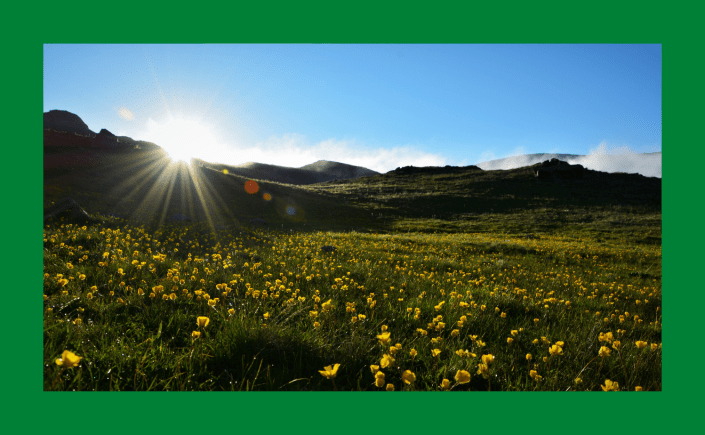
But while we complain a lot about mud season in Vermont, there is more to spring here than mud. Nature awakens from its long winter nap with bright skies and crisp breezes that convey hope and promise renewal. The melt-off that creates all the mud also fills Vermont’s streams, brooks, and creeks to capacity (or beyond), and the water crashing down the falls of Otter Creek offers a stunning display of power and beauty. The warmth of the sun, the emergent grass, heck, even the mud, are beautiful sights to bear after months of frigid cold and fleeting daylight. Like every other season, spring in Vermont reminds us of what beauty looks like.
Celebrating beauty in the natural world is not just a preoccupation for flannel-wearing, granola-crunching Vermonters like me. Beauty is an object worthy of Christian celebration too, because it is how the Bible starts the story of God’s love affair with the world. The opening lines of Genesis offer a poetic celebration of creation. The world around and beyond us humans is good. We know this because Genesis not so subtly tells us in stanza after stanza of the creation ode: “God saw everything that [God] had made, and indeed, it was very good” (Gen 1:31).
If we insist on viewing everything with ourselves at the center of the universe, then we might think creation was good because it was set up perfectly to serve us human beings. But maybe the world is good just because it is beautiful, and it is beautiful simply because God declares it is. Its beauty flows from God’s own animating beauty. Long ago, the New England preacher Jonathan Edwards wrote a treatise called The Nature of True Virtue, in which he wrote that beauty as we normally experience it in life is the apprehension of things in “mutual agreement,” a “visible fitness of a thing to its use” that is pleasing to us, rationally and emotionally. It is the experience of things like order, proportionality, and agreement, or the delight we feel when something fits smartly as part of a greater impressive whole. Edwards believed that this beauty we experience in the world around us reflects “some image of the true, spiritual original beauty,” which he understood as “union and consent with the great whole” of Being in general (that is, God). In other words, we experience things as beautiful—physically, emotionally, or morally beautiful—when we are struck by the way they reflect the goodness of God and the wonder of God’s “big picture” in which we all exist.
Edwards is adamant that things are not beautiful because we say they are. We sense beauty in our world because those things are beautiful already, and they are beautiful because they participate in God. God is “the ground both of their existence and their beauty.” God is the source of the beauty we experience, and the beauty in our world is an experience of God. So despite the popularity of the cliché, it turns out that beauty is not in the eyes of the beholder, at least not if the beholder is mortal. Beauty resides in the heart of God and extends outward to the things we experience as beautiful; in that way, beauty reflects the inherent value of the things we behold. Beauty is a gift, to the one who is beautiful and the one who regards that beauty.
To experience beauty is to participate in the divine. Listening to wind rushing through tall pines can be an encounter with God. Taking in the intensity of green on a countryside in June can be a spiritual epiphany. Gazing with wonder on the intricate camouflage worn by tree frogs is an experience of the holy. Basking in the serenity of a simple afternoon, following your lovely spouse in tow as she makes her way around a local nursery, is beautiful. Sharing friendship in a loving community is beautiful.
As with everything else in the Christian life, the gift of beauty comes with corresponding responsibility. Ecologically, we have a responsibility to protect that which God has given us as beautiful, not just so there will be an earth for future generations of people to use, but because it is God’s world and valuable as such. Interpersonally, we have a responsibility to name the beauty in ourselves and others. Especially to the bullied and harassed, to the marginalized and ostracized, to those who do not conform to what society considers right or normal, we are charged as ambassadors of God to declare: you are beautiful, just as you are, because God loves you as you are.
There is a lot of mud in the world right now—in our politics, media, entertainment, schools, and communities. Maybe what the world needs right now are people who point out the beauty in the midst of the mud. Calling out beauty when we see it, everywhere, sounds like a suitable job for the people called church.

It is an expression of Christian charity
Lost in the traumatic aftermath of George Floyd’s murder, including President Trump’s assault on the right to free speech and peaceable assembly, the US Supreme Court issued a ruling on another First Amendment issue late last week. The case involved a church suing the State of California for prohibiting large in-person services during the COVID-19 pandemic. The church argued that assembling as church is a fundamental expression of Christian faith, and that the order to limit gatherings is therefore a violation of the First Amendment. A majority on the Supreme Court disagreed, ruling that the prohibitions on mass gatherings did not constitute a violation of religious freedom.

My friend Steve Martin serves as Director of Communications and Development for the National Council of Churches in DC. He and I share a love of motorcycles and a love for the church. In the following essay, he writes beautifully about what motorcycling might disclose about being American and being Christian, as well as how church might refract our identity with other “tribes.” Even though he rides the wrong kind of bike, I’d like to share what he wrote:
Motorcycles, tribalism and America – What I learned riding in Rolling Thunder

Today many Christians observe Epiphany, commemorating the coming of wise men to see the infant Jesus, following the star until they found him in Bethlehem. Epiphany concludes the traditional twelve days of Christmas, and what it adds to our Christmas celebration is the Good News that God’s presence is a Gospel meant for all the world. The star shines for the redemption of all of humanity. The wise men who sought out the infant Christ came from beyond the family lineage of Israel, and together they symbolize the longing for life and love, hope and peace, that every member of the human community shares. As the Gospel of John’s opening lines declare, “What has come into being in him was life, and the life was the light of all people. The light shines in the darkness, and the darkness did not overcome it.” On Epiphany we celebrate that the imperative of the prophet Isaiah is an invitation for the whole world: “Arise, shine; for your light has come, and the glory of the Lord has risen upon you.” Epiphany may be a specifically Christian holy day, but in our celebration we the Church are simply what theologian Karl Barth once called the “provisional representation of all humanity.” In our Epiphany celebration, we foreshadow a hope for all people, the light of life, Emmanuel, God with us!
 James Calvin Davis
You must be logged in to post a comment.