I’m thrilled to announce that my latest book is now available to order! Official launch information will follow soon. In the meantime, here is a description and link to the publisher’s website:
How can celebrating the “holy days” of American culture help us to understand what it means to be both Christian and American? In timely essays on Super Bowl Sunday, Mother’s Day, Independence Day, Thanksgiving, and other holidays of the secular calendar, James Calvin Davis explores the wisdom that Christian tradition brings to our sense of American identity, as well as the ways in which American culture might prompt us to discern the imperatives of faith in new ways. Rather than demonizing culture or naively baptizing it, Davis models a bidirectional mode of reflection, where faith convictions and cultural values converse with and critique one another. Focusing on topics like politics, race, parenting, music, and sports, these essays remind us that culture is as much human accomplishment and gift as it is a challenge to Christian values, and there is insight to be discovered in a theologically astute investment in America’s “holy days.”
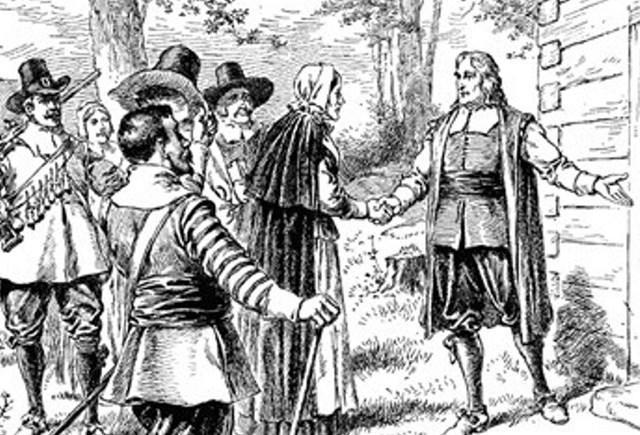
For twenty years I’ve been writing and talking about civility, the public virtues necessary for a healthy democracy. My work on civility got its start in a dissertation and two subsequentbooks on Roger Williams, the founder of Rhode Island and the first American prophet for religious freedom.
Recently I enjoyed a rare opportunity to talk about his importance for a podcast called Multifaith Matters, which “explores various facets of loving God and multifaith neighbors through interviews with pastors, ministry leaders, and scholars” and “models neighborly multifaith conversations with members of various religious traditions.” The podcast is produced by Multi-Faith Matters dot org, an organization whose mission is to “help evangelicals fulfill the Great Commission and the Great Commandments (love of God and neighbor) while maintaining faithfulness to evangelical convictions.” To achieve this, they facilitate dialogue and relationships among people of all faiths.
Roger Williams is known for his religious toleration, but he was also fiercely dogmatic, and his ability to hold together deeply held convictions and respect for others makes him an interesting case study for our time. In our conversation here, after a brief biographical sketch, I delve into Williams’s ideas about the Puritan establishment in Massachusetts, natural law, religious freedom, civility, and the proper relationship between church and society.
You can listen to the podcast here on its website, or via several other podcast platforms, including Spotify.
If you heed the dire warnings of social media—and some conventional media outlets—you will know that we are living in the end times, for the end of the world as we know it began on November 3rd. If not the end of the world, then we are living the end of democracy. Depending on what political perspective you’re reading at the time, the end of our country (or the world) is coming as a result of encroaching socialism or persistent fascism. Be vigilant, for you know not what day the end will come, but it is coming!
This kind of dire prediction of the cataclysmic end of human history is called apocalypticism, and though the Bible didn’t invent apocalypticism, it contains a bunch of it. Some of the Old Testament prophets engaged in that end-times talk, and of course the Book of Revelation is all about the end of human history, the final battles between God and Satan, and the ultimate triumph of God’s Kingdom. The earliest generation of Christians thought this end of the world was coming very soon. Jesus, the Messiah of God, had come to proclaim the nearness of God’s Kingdom. Jesus was crucified, but he rose from the grave as a testament to God’s power to save. And then he ascended to heaven to sit at the right hand of God the Father, promising to come again to usher in God’s final Kingdom on earth.
I am leading a study for my home congregation on “Being the Body of Christ in a Socially Distant World.” We are considering the ways in which the pandemic has challenged our habits of being church, but we also are talking about the new practices we have discovered that may be useful to our ministry and fellowship even when this present darkness is behind us. This coming week, we will be talking about virtual worship, particularly the virtual practice of Communion, or the Lord’s Supper. The following are resources I assembled to give them food for thought on the subject. Perhaps they will be useful to some of you as well.
~~~~~~~~~~~~~~~~~~~~~~~~~~~~~~~~~~~~~~
Take a look at these five short and accessible articles wrestling with the impact of COVID-19 on Christian worship, especially the celebration of Communion.
An NPR story that confirms that much of our experience with virtual church—good and bad—is being felt by churchgoers all over the country:
2. A Lutheran makes the argument for why we should not do the Lord’s Supper at home during the pandemic. Does his argument hold if we don’t subscribe to the Lutheran understanding of Communion? What is the Lutheran understanding? Wait—what is our understanding of Communion?
3. An “advisory opinion” of the Presbyterian Church (U.S.A.) on whether it is appropriate to celebrate Communion virtually. Try to read past all of the polity references (i.e., who has authority) to understand what the meaning of the Lord’s Supper normally is in this denominational tradition, and how it can be justified virtually in times of pandemic. Does this perspective from the UCC’s “cousin” in Reformed Christianity help us think about our practice?
I had the great pleasure this past Sunday of celebrating World Communion Sunday with Westminster Presbyterian Church in Albany, NY. The topic of my sermon was “Character as Social Witness.” The service was particularly meaningful because joining us at the Table was Rev. Akrong from Westminster’s partner congregation—Greenwich Meridian Church—in Tema, Ghana. Thanks to the Rev. Heather Kirk-Davidoff for the invitation to be part of this meaningful service:




 James Calvin Davis
You must be logged in to post a comment.