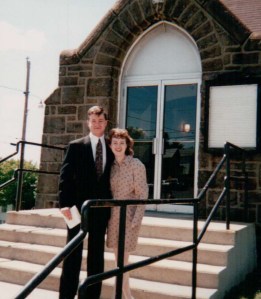
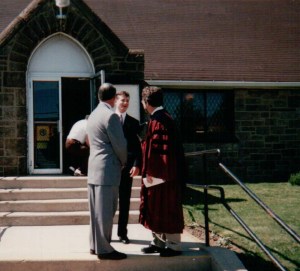
On June 5, it was my great pleasure to commemorate the 25th anniversary of my ordination by preaching and worshiping at Putnam United Presbyterian Church in Washington County, NY. Below is an audio recording of my sermon, which is on Pentecost.
For the next three weeks (June 5, 12, and 19), I have the great pleasure of leading worship with my friends at Putnam United Presbyterian Church, in Putnam Station NY. Next week also marks the 25th anniversary of my ordination as a minister of the Word and Sacrament in the Presbyterian Church USA. The kind folks at Putnam have hosted me as a guest preacher for over ten years, so I am deeply grateful that they were willing to share this milestone with me. It is so much more meaningful to observe my ordination anniversary with friends, and what better way to observe it than with a small Presbyterian congregation that reminds me of the one that raised me in the faith? So if you’re in the area this month, drop in for worship at 10 a.m. I am certain you will find the people at Putnam United as warm and welcoming as I have all these years.
I had the pleasure of preaching on the First Sunday in Advent in my home church, the Congregational Church of Middlebury (VT). The theme of the sermon was “Hope in the End Times.” What do biblical depictions of apocalypse have to do with Advent waiting, particularly in a moment like ours? Is there actually hope to be found in predictions of the world’s end? I believe there is, but not where you might think. The sermon begins at 30:30.
I grew up in a small coal town in western Pennsylvania. For many years, Colver was a typical company town, reflecting the power differential between miners and mine owners, and reinforcing mining families’ total dependence on the company for income and services. Even the name of the town reminded its citizens of company dominance, deriving as it did from a mash-up of the owners’ names: Coleman and Weaver. But by the time my father returned to his hometown to work in the mines, the industry’s influence over the town and surrounding area was mitigated by another force, the labor union. Once free as “job creators” to dictate the working conditions and living arrangements of their employees, coal companies now had to negotiate with the collective power of the United Mine Workers of America (UMWA).
For most of my childhood, the United Mine Workers were led by Richard Trumka, who passed away recently after a lifetime of advocating for the American laborer, in roles with UMWA and the AFL–CIO. For his part, my father was active in UMWA District 2, Local 860, even after a back injury ended his active employment. Dad hurt his back when I was seven, but by the early eighties his fellow miners found themselves unemployed as well, displaced by the end of workable coal strips underneath our sleepy town. The coal industry remains the centerpiece of Colver’s history, but by the time I became a teenager, the mine’s demise (and the absence of any substitutable prospect of work) was the defining reality of the present.
This summer I have been watching a CNN documentary mini-series called Jerusalem: City of Faith and Fury. One historian on the show invokes the saying, “the past is never the past,” and goes on to remark that “if there is one place on earth where that is true, it is Jerusalem.” What makes Jerusalem the most conflicted place on earth is the number of communities who lay claim to the city, especially the historical depths of those claims. The three Abrahamic faiths all claim Jerusalem as a holy city, and their adherents regularly make pilgrimage to it. The importance of Jerusalem has led to millennia of contested claims to the city that continue to this day, for Jerusalem physically captures a sense of the holy for the groups who lay claim to it; it symbolizes something important about the identity of those communities. To lose the city is to be displaced, to be cut off from the sacred in a visceral sense. This isn’t just about territory. It is about belief, identity, a sense of grounding in the moral cosmos, a connection with the holy. The city’s religious significance—and the Abrahamic faiths’ inability to imagine it as a shared space—is what makes the history of Jerusalem so tragic.
The conflict around Jerusalem is a particularly painful example of the intense importance of place to our sense of meaning. We are embodied creatures, so time and space are important to how we understand ourselves and our place in this world. Our sense of place reflects and gives identity, and when we are disconnected from meaningful places, we feel displaced—rudderless, vulnerable, perhaps not really ourselves.





 James Calvin Davis
You must be logged in to post a comment.