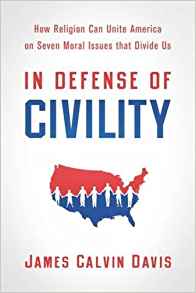
In Defense of Civility selected in reader survey as “the book you keep going back to”

The Presbyterian Outlook recently surveyed their readership, asking for compelling and transformational recent books. In Defense of Civility was mentioned in response to the question, “What is the book you keep going back to and why?” Andy Kort, senior pastor of First Presbyterian Church of Bloomington, Indiana, shared that in the book Davis “highlights issues like war, abortion, marriage, separation of church and state, and more in a way that not only helps me articulate my own thinking, but also is very helpful in allowing me to better understand the opposite view. He does this all while making the case for a civil discourse.”

You can find out more about all of the readers’ choices for captivating books here!

Witnesses of These Things

A sermon preached at the Congregational Church of Middlebury, Vermont

April 15, 2018 (Third Sunday of Easter)
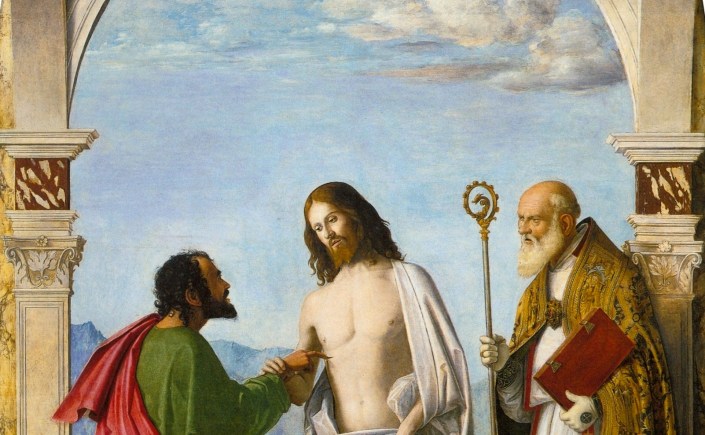
Text: Luke 24: 36-49

I was having breakfast with a friend of mine this week, a colleague at the college, and the subject of church came up. My friend grew up in the Roman Catholic Church, but he doesn’t associate with his religion anymore. “Someday you and I need to have a conversation about this church thing,” he said to me. “I have to admit that I’ve distanced myself from that stuff in my middle age. I guess I’m too much of a scientist; I need things to be empirically validated to believe them. I’d love to talk to you about how you keep religion and the life of the mind together.”

Many of us have had similar conversations; some of us have had them with ourselves. We’re not always sure we buy all of the things read and mentioned and claimed here at church. What do we do with the disconnect between the assertions of the faith and the requirements of the critical mind?

Continue reading

Forbearance now available on Kindle

What happens when we approach disagreement not as a problem to solve but as an opportunity to practice Christian virtue?

In this book James Calvin Davis reclaims the biblical concept of forbearance to develop a theological ethic for faithful disagreement. Pointing to Ephesians and Colossians, in which Paul challenged his readers to “bear with each other” in spite of differences, Davis draws out a theologically grounded practice in which Christians work hard to maintain unity while still taking seriously matters on which they disagree.

The practice of forbearance, Davis argues, offers Christians a dignified, graceful, and constructive way to deal with conflict. Forbearance can also strengthen the church’s public witness, offering an antidote to the pervasive divisiveness present in contemporary culture.

“Forbearance. It’s an old-fashioned word, perhaps, but if ever we needed to recover its use, now is the time. Our politics and economics, our communities and churches, and even our families are fractured by polarizing disagreements that often grow into debilitating conflicts. In this discerning book James Calvin Davis deftly narrates the meanings, spirit, power, and practice of ‘bearing with one another’ as a fundamental Christian civic virtue, one that can lead us into ways of dealing with our conflicts that are marked by wisdom, justice, faithfulness, and hope.” –Craig Dykstra, Duke Divinity School

Forbearance: A Theological Ethic for a Disagreeable Church, Kindle Edition

The Christian Misanthrope

Can you be a Christian misanthrope? The Merriam-Webster Dictionary defines a misanthrope as “a person who hates or distrusts humankind.” Precisely used, the term refers to someone who retreats from human interaction out of a rejection of human community. Understood as such, it should be pretty clear that you can’t be a Christian misanthrope, for that’s a contradiction in terms. Christianity’s emphases on love and community make our faith tradition obviously incompatible with someone who would declare that he is done with humanity.

So I will admit that the phrase “Christian misanthrope” is a bit of intentional literary exaggeration, an oxymoron meant to grab attention. But I also use the term because I have been called a misanthrope from time to time—kiddingly, I hope, by friends who know my strong preference for alone time and independence. Even to call it a “strong preference” seems an understatement. I often tell people that when I underwent my psychological evaluation for ordination to ministry, my tests concluded that if I were any more introverted, I would quite simply be dead. My default is to be alone; it requires intention for me to seek out the company of other people. I like quiet; I often prefer time to talk to myself over talking with others. A good weekend to me is spent walking in the woods behind my house, sitting on my porch staring at the deer in the field across the way, or tinkering with a project in my garage.

Continue reading

Prayers Not Our Own

A sermon preached at the Congregational Church of Middlebury, Vermont

February 18, 2018
Text: Matthew 6: 7-13

My Pentecostal-leaning grandmother knew a good preacher when she saw one. Modeled after the televangelists with whom she spent much of her time, her standard for a good preacher was one who just “preached the Word,” spontaneously and extemporaneously, not with a sermon crafted in the week before but in a heartfelt connection with the Bible that lived from the moment. Good preachers, she would say, prayed the same way. A good prayer isn’t written out; it comes from the heart—spontaneously, with words that come directly from the Spirit in that moment.

When I was in college, the campus chapter of Intervarsity Christian Fellowship was my main community of friends, and there too the evangelical model of prayer was consistently lifted up and practiced. Good prayer was heartfelt, personal, spoken in the moment, with a generous use of the word “just” that I never quite understood—as in “Jesus, we just thank you for your love.” Good prayer finds its expression in the moment and from the heart.

Then I went to seminary and discovered a number of things, including that on the topic of prayer and worship, I was a closet Catholic. Or so it seemed, because I fell in love with another kind of liturgy and prayer. In seminary I discovered prayers that are old, standardized, and passed down from one generation to another. I discovered the Episcopal Book of Common Prayer and the Presbyterian Book of Common Worship, chock-full of prepared prayers that were used in common in many different places and many different times. I learned the art of crafting prayers carefully, ahead of time, with attention to language more like poetry than conversation. Prepared, shared, standardized prayer became authentic and good to me.

Continue reading