Friendship as Holy Time

This past week I was blessed to spend a couple of days hanging out with friends in Greenville, South Carolina. I have known Susan, Ken, and Leeann for only three years or so, when I joined a committee for the Presbyterian Church (U.S.A.) that they were already serving. In a short period of time, they have become some of my closest friends. When we are working together, we are writing theology exams for our denomination’s ordination process, and it is wonderful to bond with them in our common love of theological tradition and the church. But what has pulled us together runs deeper than theology. These friends understand (and to varying degrees share) my extreme introversion. They endorse and encourage my love of bourbon and gin. Perhaps most important of all, they match my school-bus sense of humor with disgusting antics of their own. (Well, Susan and Leeann are happy to meet me in the gutter with inappropriate jokes and innuendos, while Ken futilely tries to model humor that is a little less adolescent.) They care about me, not because I do something for them, but simply because I am. Two days with this Fun Bunch yielded more laughs and spiritual restoration than I have enjoyed in a long, long time. It was holy time.
SCKen

Continue reading

Christian Witness in the Two Americas

In the most racially divisive moment in the United States since the Civil Rights Movement, we are discovering that we are not “one nation under God,” but two Americas, living in the same national space. One America recognizes that we are becoming increasingly diverse as a nation, with experts projecting that people of color will outnumber white citizens in less than a generation. This America welcomes diversity and celebrates how rich and interesting our country becomes with the embrace of racial, ethnic, cultural, and sex/gender difference. This America accepts the truth that to live up to our moniker as the “city on a hill,” we must embrace our tradition as a nation of immigrants and establish border policies that are both disciplined and gracious. This America acknowledges that our national history is built on injuries to people of different races, cultures, and countries, but it seeks to remedy that legacy by the confession of sins and commitment to a future of fairness and mutual respect.

But there also is a second America, gripped by fear and simmering with resentment, inhabited by groups used to occupying the majority and serving as the measure of what is normal, but who now are in danger of losing their country to an element that feels foreign and alien.

Continue reading

Kindle sale: Forbearance

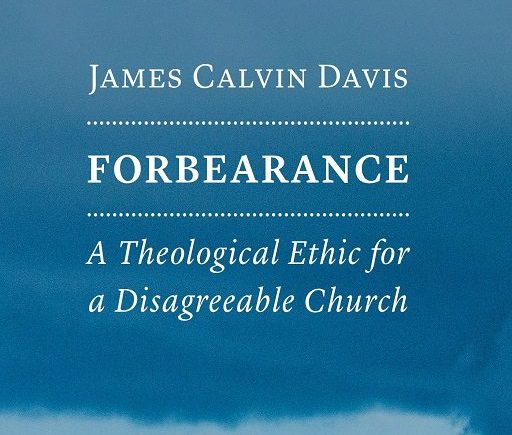
The Kindle version of Forbearance: A Theological Ethic for a Disagreeable Church is currently on sale for $1.99!


What happens when we approach disagreement not as a problem to solve, but as an opportunity to practice Christian virtue?

In this book, James Calvin Davis reclaims the biblical concept of forbearance to develop a theological ethic for faithful disagreement. Pointing to Ephesians and Colossians, in which Paul challenged his readers to “bear with each other” in spite of differences, Davis draws out a theologically grounded practice in which Christians work hard to maintain unity while still taking seriously matters on which they disagree.

Palms and Pies

A sermon preached at the Congregational Church of Middlebury, Vermont, on April 14, 2019

There is a movement within Christian worship in the last couple of decades to observe this day of the Christian year as Passion Sunday, or Palm/Passion Sunday, instead of just Palm Sunday. In other words, on this Sunday we observe in worship the triumphal entry of Jesus into Jerusalem, but in the deliberate context of the rest of Holy Week. That often means including Scripture not only about the entry but also about the Passion of Christ, and to have the movement of our hymns go from “All Glory, Laud, and Honor” at the beginning of the hour to “O Sacred Head, Now Wounded” at the end. This tendency toward observing Passion Sunday has historical connections, but the main concern that motivates it is to ensure that churchgoers get the whole picture. The reality is that most Protestants don’t come to church between Sundays, so if we observe only the triumphal entry today, most churchgoers will go from happy day (Palm Sunday) to happy day (Easter) with no opportunity to reflect on the all-important moment of Christ on the cross. And without the cross, however we interpret it, we do not understand the significance of Christ.

I think there’s a lot of wisdom in the move toward Passion Sunday and the concerns that motivate it. And yet there is cost. The cost is that in our movement toward the cross we do only a quick run past the spectacle of Palm Sunday. In our effort to encapsulate the full meaning of Holy Week in a Sunday service, we risk spending very little time on the beginning. The triumphal entry disappears in the shadow of the cross, and we leave church wondering, “Why did we pass out those palms?”

Continue reading