
A sermon delivered at Putnam United Presbyterian Church (NY) 3/24/2024
Palm Sunday
Holy Week can be a particularly difficult week for Christians to focus, because there is a lot going liturgically and theologically. This one week puts before us the trajectory of Jesus’ final days, from popular hero to humiliated scapegoat. We witness the crowds hearing what they wanted to hear and seeing what they wanted to see in Jesus early in the week, only to reject him when they realized he was preaching a kingdom message that would challenge them, not placate them. They realized that he was unwilling to play the game that other would-be political leaders played. He would not promise to overthrow the Romans and their vermin sympathizers on day 1 of his rule. Instead, he talked on and on about a kingdom of love and righteousness and peace. And for this, the people’s chants of “Hosanna in the highest!” turned into mob taunts to hang him, and they abandoned him to the brutal devices of the Roman Empire.
It can be a lot to focus on, and it can be difficult to hear these well-tread stories of palms and Passion in fresh ways. But hear the story we must, for this week we consider the most important act in human history, from the perspective of our faith tradition. No week was ever more important than the one Jesus spent in Jerusalem. No moment of decision was ever as monumental as his commitment to sacrifice himself for the good of humankind. No event has ever changed the world the way the event of the cross has. From the perspective of Christian faith, this week—that begins with celebration, descends into chaos, violence, and despair, and then points around the corner to the triumph of divine love—gives Christians our identity, provides the content of our message, motivates our work, and gives us our hope.
This is the week in which the Gospel of God’s love was unleashed, and the community of the church was made. This is the week when divine Love took the best shot evil could muster, when God demonstrated the depths to which God would descend in order to reclaim us as God’s own. This is the week that tested the sincerity of that promise we rehearsed at Christmas—Emmanuel, God with us—and demonstrated the wondrous love that redeems and sustains our tortured world.
One aspect of the crucifixion story that is important to consider seriously is how humiliating it was to die as Jesus did. In first-century Roman culture, crucifixion was a way to dispense publicly with common criminals—thieves and murderers. We are reminded of this when the gospels point out that Jesus was crucified with two criminals. These two men were base social deviants, low-life bandits, and Jesus was executed right alongside them, humiliated by association. Crucifixion was not just a brutal and barbaric way to die, it was a dishonorable method of execution. It was publicly horrific to make a point: don’t mess with the Romans. And this horror makes the contrast with the palm-lined procession earlier in the week all the more powerful. Jesus, whom the crowds were willing to adore as long as he catered to their expectations, was by the end of the week cast aside like human trash.
In the earliest generations of the church, this depiction of Jesus’ death was hard for some Christians to swallow. Such a humiliating death seemed to make God not terribly powerful, not terribly reliable. We know early Christians wrestled with this idea of a suffering Christ, because we have evidence of their attempts to tell the story of Jesus a different way. For instance, years ago, archaeologists discovered an ancient text called The Gospel of Judas, which represents an alternative view of Jesus and his ministry. One thing you notice from the fragments of that text is that Jesus doesn’t really sound like the man in the biblical Gospels. He’s more magician than man in the Gospel of Judas, more ghostlike than flesh and blood. He’s all about pithy sayings and strange miracles, and the concrete events of his life are less emphasized. I think that one thing you see in a text like this is an early Christian community wrestling with the implications of Jesus’ death. If Jesus died such a humiliating death, what does that mean for God’s reliability? If God couldn’t save Jesus, how can God save me? The crucifixion raised real doubts for the early Christians, so they told the story a different way, to emphasize something else.
But the gospels of our Bible—and the generations of Christians who have followed them—don’t shy away from the crucifixion. The gospel as we have it in our Bibles assures us that the good news of God in Christ Jesus is told in part through his humiliating death. The tragic part of Holy Week is not something to ignore or reinterpret. It’s an important part of the point that God was trying to make in Jesus.
In taking the worst that humanity could offer, he offered the best that God could give.
Heralded as a political liberator during his first days in Jerusalem, Jesus managed to disappoint many who had preconceived notions of what he should do and be. He was rejected, despised, tortured, and killed. But in taking the worst that humanity could offer, he offered the best that God could give.The medieval monk St. Abelard taught that Jesus became human and died ultimately for two reasons: to demonstrate God’s infinite love for the world and to inspire our own. In an evocative metaphor, twentieth-century theologian Karl Barth argued that in Jesus Christ, God traveled over the far-country, traveled the miles between us and God, traveled to the point of death, to find us and bring us back to God. Jesus died, said Barth, in order to show just how far God was willing to go to save us from ourselves. The crucifixion is an essential part of the story of God’s persistent love.
We are saved by a broken body and a promise of steadfast love sealed in shed blood. This divine love that would go to such lengths to seek us out should inspire us to practice a little love ourselves. Christ gave his body for us, says the Holy Week gospel, and now he invites us to be his self-giving body for the world.
The crucifixion is an essential part of the story of God’s persistent love.
I think the humiliation in the cross is particularly important for us to emphasize in our moment. As was true among ancient Christians, plenty of Christians today are uncomfortable with the idea of a suffering God. In fact, in some circles of American Christianity these days, there is a movement some observers call “muscular Christianity,” that subscribes to a picture of Jesus not as peaceful, humble, and humiliated, but as muscular, strong, a man’s man, jumping down off the cross, kicking butt and taking names. This interpretation (if we can call it that) is particularly popular among Christian Nationalists, and the implication is that true Christians, true Christian men, are like this Jesus—full of bravado for Jesus, doing battle with all of the people in this world who are enemies of Christ, by which they usually mean gay people, tree-huggers, and Democrats. And then by extension, muscular Christians assert that public leaders who talk tough and are confrontational are seen as extensions of this kind of Jesus. In fact, sometimes their faces are superimposed on a muscle-bound Jesus with a cross and printed on posters, to be carried at rallies and such.
Let me be clear. (And this is not a political commentary per se, but a theological one.) That depiction of Jesus, and the attribution of that kind of personality to Jesus, is the most offensive blasphemy I have encountered in my lifetime.
“Jesus is going to kick your ass” is not the gospel. “Jesus is going to get his ass kicked for you” is the gospel played out in this Holy Week.
The Apostle Paul assures us that Jesus “did not regard equality with God as something to be exploited, but emptied himself, taking the form of a slave, being born in human likeness. And being found in human form, he humbled himself and became obedient to the point of death—even death on a cross” (Philippians 2:5–8).
The Apostle Paul would not recognize the depictions of Jesus in some corners of American politics today. If this Holy Week tells us anything, it is that God so loved the world that God sent Christ into the world to suffer and die, to demonstrate the depths to which God was willing to descend to call us back to God. If Holy Week is about anything, it is about wondrous, inclusive, persistent love. If Holy Week is about anything, it is an invitation to follow that Christ, to be obedient to God to the point of sacrifice, to love God by loving others to the point of sacrifice, and to empty ourselves that God might fill us again with the good news coming ’round next Sunday.
Christian faith isn’t about winning, at least not in the way that winning is tossed around as a measure of success in today’s political world. Christian faith is about winning by losing, winning by loving. Christian faith is an invitation to follow a Messiah who committed to losing in order to win us to love. The invitation to follow that “lovable loser” is an invitation to become more self-giving human beings ourselves, like the crucified Lord we follow. Take up your cross and follow me, said Jesus. The Passion of Christ makes a claim on us, to live for others. Those we know well and those we don’t. Those with whom we agree, and those with whom we differ. Those we like, and those we really don’t.
If Holy Week is about anything, it is about wondrous, inclusive, persistent love.
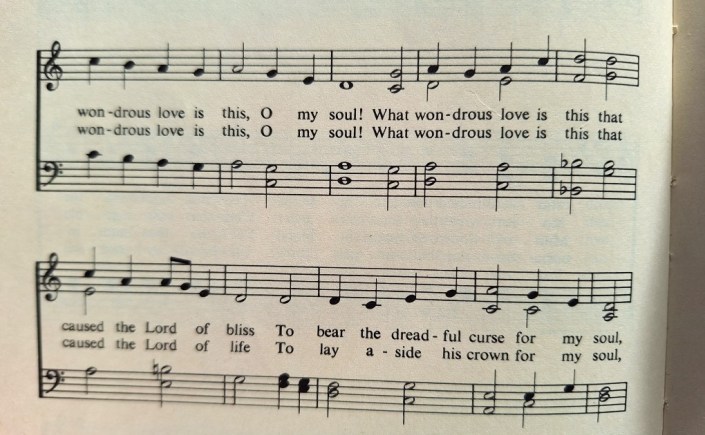
In the end, the Passion is a love story in which we are all characters. What wondrous love is this, O my soul? It is divine Love so faithful that God entered into human experience to meet us where we are, to find us in the shadows of death and self-destruction to bring us back home to God. This week reminds us of a wondrous love so steadfast that God still endures the world’s rejection and our brutal inhumanities in order to show us by that divine persistence that Love ultimately triumphs over all. “For God so loved the world, that he gave his only begotten Son, that whosoever believeth in him shall not perish, but have everlasting life” (John 3:16). This is the good news waiting for us on the other side of this hard, holy week. Amen.
 James Calvin Davis